**
- Home
- City Projects
- South Tacoma Groundwater Protection District
South Tacoma Groundwater Protection District
The South Tacoma groundwater aquifer supplies up to 50% of Tacoma’s total water demand during peak summer months, making it a critical resource for the city. Historically, the aquifer has faced significant risks of contamination due to spills, leaks, and improper disposal of hazardous substances by local industries. To mitigate these threats, the City of Tacoma established the South Tacoma Groundwater Protection District (STGPD) in 1988.
The South Tacoma Groundwater Protection District is an overlay zone designed to protect the aquifer by regulating the handling, storage, and disposal of hazardous materials within the area that recharges the aquifer. It also imposes additional restrictions on high-impact land uses that could further jeopardize the aquifer’s quality or quantity. These measures aim to safeguard public health, ensure a reliable water supply for future generations, and protect the city from the financial and environmental consequences of groundwater degradation. 
Contact
Planning and Development Services
(253) 591-5030
zoning@[SITEURL]
STGPD Area Map (Click to enlarge.)
.jpg "STGPD Area Map")
Questions and Permits
General STGPD Questions
For general questions about zoning, land use, or the South Tacoma Groundwater Protection District, please contact:
zoning@[SITEURL].
STGPD Permit Questions
Questions related specifically to STGPD permits, including application requirements and review, should be directed to the Tacoma–Pierce County Health Department. Please visit their website for permit information and guidance.
South Tacoma Groundwater Protection District (STGPD) Code Update Adopted
The Tacoma City Council adopted the South Tacoma Groundwater Protection District (STGPD) Code and related amendments to Tacoma Municipal Code (TMC) Title 13 on September 9, 2026.
For details, view adopted Amended Substitute Ordinance No. 29051 here. Changes in the STGPD Code are shown in track changes.
Planning Commission’s Review
The Planning Commission has forwarded its recommendation for the STGPD code update to the City Council. This document outlines the planning requirements and public engagement and presents an overview of the STGPD code update. Additionally, it includes a summary of the Commission’s deliberations and highlights the amendments made in response to public comments received during the Commission’s public hearing on May 21st.
Why did the City update the STGPD Code?
A Critical Aquifer Recharge Area (CARA) is an area that helps recharge the groundwater we rely on for drinking water. Protecting these areas is essential to ensure clean and safe water for our community now and in the future.
State law, through the Growth Management Act (GMA), requires cities to identify and protect Critical Areas—including wetlands, fish and wildlife habitat conservation areas, frequently flooded areas, geologically hazardous areas, and critical aquifer recharge areas. Cities must review and update their local Critical Areas regulations at least every ten years, using the best available science (BAS).
The South Tacoma Groundwater Protection District (STGPD) is one of these critical areas. The City updated the STGPD code in Tacoma Municipal Code (TMC) 13.06.070.D, which contains the primary regulations for the district. Related sections—TMC 13.06.040.J, 13.06.060, 13.06.090.B, and 13.06.090.J—were also updated to align development standards, such as landscaping, tree canopy, and lot coverage, with the goals of the updated STGPD Work Plan.
The code was updated to:
- Ensure consistency with state laws and the best available science
- Address gaps or inconsistencies in the previous code
- Strengthen groundwater protection and prevent contamination
- Align development standards with the goals of the Updated STGPD Work Plan
These updates provide clearer, stronger regulations that help protect Tacoma’s groundwater while supporting safe, responsible development in the STGPD.
How does the updated code improve integration with the City of Tacoma’s Critical Areas Ordinance (TMC 13.11)?
The update establishes the STGPD as a Critical Aquifer Recharge Area (CARA) under the GMA and TMC 13.11 and recognizes it as part of the Central Pierce County Sole Source Aquifer (SSA).
Previously, the STGPD code did not clearly connect to the Critical Areas Preservation Ordinance (TMC 13.11) and lacked full alignment with GMA requirements. The adopted changes provide that alignment.
The City is also currently in the process of updating Critical Areas Ordinance in TMC 13.11 Critical Areas Preservation, including for improving integration of aquifer recharge areas into that section of the code.
How has the STGPD map changed?
The updated STGPD map now:
- Includes the Manitou neighborhood (annexed in 2026)
- Shows the Wellhead Protection Area Time-of-Travel Zones within the STGPD
- Shows the entire Central Pierce County Sole Source Aquifer (SSA)
What are the changes to underground storage tanks and metal recycling / auto wrecking facilities standards?
The adopted code permanently prohibits underground storage tanks and metal recycling/auto wrecking facilities in the entire STGPD. These uses had previously been prohibited under a temporary moratorium.
How is “Periodic Update” defined now?
The code clarifies that:
- Reviews will occur at least once every ten years, consistent with the GMA’s update schedule.
- Best Available Science will be used to evaluate new or evolving threats.
- The process will involve Environmental Services, Tacoma Water, Planning & Development Services, and the Tacoma-Pierce County Health Department (TPCHD).
What are the changes to enforcement and monitoring?
- The update strengthens enforcement by adding tools such as stop-work and stop-use orders for serious or emergency violations, allowing faster action when the aquifer is at risk.
- Both the Tacoma-Pierce County Health Department (TPCHD) and Planning & Development Services (PDS) now have authority.
What are the changes to general program awareness?
The STGPD program now focuses more on education and outreach. Previously, outreach was mostly tied to enforcement and targeted regulated businesses. Now, both residents and businesses are included.
The City of Tacoma and TPCHD are responsible for:
- Promoting best practices for protecting Critical Aquifer Recharge Areas (CARAs)
- Increasing awareness about water conservation
These changes help the community better understand how to protect Tacoma’s groundwater.
What are the changes to stormwater infiltration?
The updated STGPD code now prioritizes stormwater infiltration in aquifer recharge areas to protect and recharge the groundwater, as long as it is safe.
New requirements include:
- Conducting soil contamination assessments to check if infiltration is safe and feasible before it is used.
These changes help ensure groundwater remains clean while supporting safe ways to manage stormwater.
What are the changes to impervious surface standards?
The STGPD code adds new regulations in TMC 13 to further limit impervious surfaces, in addition to the existing regulations under TMC 12.08D and the Stormwater Management Manual. These changes help protect and recharge groundwater.
The main additions include:
- New landscaping standards for the South Tacoma Industrial Districts and the Tacoma Mall Regional Growth Center
- Maximum lot coverage limits for industrial districts
The previous regulations—like requiring Low Impact Development techniques for projects adding 2,000 square feet or more of impervious surface—remain in place. Together, these measures reduce impervious surfaces, manage stormwater safely, and support groundwater protection.
What are the changes to landscaping and tree canopy standards?
The updated STGPD code adds new landscaping and tree canopy standards for industrial zones in the STGPD, the South Tacoma Manufacturing and Industrial Center, and the Tacoma Mall Regional Growth Center. These standards help protect and recharge groundwater, improve stormwater infiltration, reduce impervious surfaces, and cool the surrounding environment.
The update also expands buffer standards beyond residential transitions to more zoning district transitions, with clearer, more user-friendly guidance on the types of buffers required.
What uses are impacted as a result of the code changes?
Certain land uses are considered “high impact” because they carry a higher risk of contaminating groundwater. Within the South Tacoma Groundwater Protection District (STGPD):
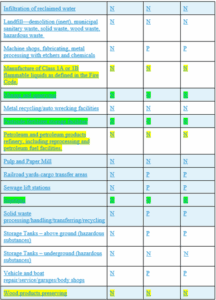
- Seven high-impact uses were already prohibited under the old STGPD code. (highlighted in yellow on the table below).
- Five additional uses were prohibited under other sections of the Tacoma Municipal Code. (highlighted in green on the table below).
- Two uses—underground storage tanks and metal recycling/auto wrecking facilities—are now permanently prohibited (previously temporarily restricted by a moratorium).
- All other uses shown in the table are new uses that are now restricted or prohibited under the adopted code.
These changes help ensure that groundwater in the STGPD remains protected from potential contamination.
(Click to enlarge.)


Are businesses currently operating in the STGPD at risk of being shut down?
No. Businesses that were previously permitted have vested rights to continue operations, routine maintenance, and limited expansion under the nonconforming use standards in Tacoma Municipal Code (TMC) 13.06.010.L.
If a business becomes nonconforming due to the updated code, it may continue as a legal nonconforming use, provided that operations do not contaminate groundwater or violate public health or environmental regulations.
Significant expansions or changes of use may require additional review or mitigation to ensure risks to the aquifer are not increased.
Why wasn’t the Bridge Industrial Project included in the Best Available Science (BAS) studies?
The BAS review for the STGPD code update was a policy and code-level assessment, not a project-specific review. It evaluated the effectiveness of the prior STGPD ordinance and the associated STGPD infiltration policy, compared Tacoma’s regulations with neighboring jurisdictions and other jurisdictions known for strong aquifer protection, assessed alignment with Washington State’s Critical Aquifer Recharge Area (CARA) and Wellhead Protection Program (WHPP) requirements, and recommended improvements.
As such, the Bridge Industrial project was not included as a case study or focus within the BAS. However, the Bridge Industrial project underwent its own separate environmental and critical areas review process under the State Environmental Policy Act (SEPA) and Tacoma’s Critical Areas Ordinance. As part of that review:
- The project received a Mitigated Determination of Nonsignificance (MDNS) with multiple conditions related to air quality, environmental health, tree canopy, traffic, and stormwater management.
- A Critical Areas Development Permit was approved with conditions requiring wetland and stream restoration, Garry Oak tree protection, permanent conservation of steep slope and forested areas, and long-term planting maintenance and monitoring.
- The stormwater system was specifically designed to treat runoff and ensure clean infiltration to groundwater or safe discharge to surface waters.
For more information about the Bridge Industrial Project, please visit: Bridge Industrial Warehouse Project | City of Tacoma.
Who manages the district?While the City is conducting the code review and update process, the current STGPD program is managed by the Tacoma-Pierce County Health Department (Health Department), which works in close collaboration with the City of Tacoma and Tacoma Water.
The Health Department regulates businesses and facilities that use or handle hazardous substances (product or waste) over 220 pounds (roughly 35 gallons) and/or have infiltration systems on site. Regulated facilities receive a permit and biennial site inspections from the Health Department. Compliance issues or complaints may trigger additional inspections. Whenever possible, inspections are meant to provide educational and technical assistance to businesses to achieve voluntary compliance.
STGPD Work Plan Health Impact Assessment (HIA)The City has partnered with the Tacoma-Pierce County Health Department (Health Department) to conduct a Health Impact Assessment as part of the research and analysis for the code update process. HIAs serve as a tool to inform decision-makers and the public of the potentially significant impacts, both beneficial and harmful, of a proposed project, policy, or program. The Health Department completed the Health Impact Assessment, and the final recommendations will be presented at the May 7, 2026, Planning Commission meeting.
STGPD Technical MemoThe City of Tacoma has partnered with the HDR/Terraphase team to update Tacoma Water’s Integrated Resource Plan (IRP), which evaluates future water supply and demand in the context of climate change and regional growth. As part of this update, the City requested an assessment of existing groundwater protection and stormwater management codes to identify opportunities for strengthening the protection and sustainability of groundwater resources. This assessment focuses on the South Tacoma Groundwater Protection District (STGPD) ordinance and related regulations. The technical memorandum summarizes the STGPD framework, its alignment with state groundwater regulations, identifies potential regulatory gaps and offers recommendations for improvements.
STGPD MoratoriumIn 2026, the City Council adopted a moratorium on underground storage tanks and metal recycling/auto wrecking facilities in the STGPD through Ordinance No. 28872. This moratorium was set to expire in March 2026 but was extended three times by Ordinance Nos. 28958, 28977, and 29020. The final extension was approved on February 25, 2026, extending the moratorium for an additional six-month period, which will now expire on September 20, 2026.
Partners and Related PlansPartners and Related Plans
Below is the list of different agencies and their roles in managing, monitoring, and implementing the STGPD program.
The STGPD code review and update is being coordinated across multiple departments and agencies through their ongoing planning initiatives. The following is a summary of these initiatives:
- One Tacoma: Comprehensive Plan
Tacoma’s Comprehensive Plan is an important tool that establishes the City’s future vision and policy direction, as well as guiding growth and development over the next 25 years. The City of Tacoma is in the process of updating the Plan which is expected to be completed by June 2026. - Critical Areas Ordinances Update
The City’s Critical Areas Preservation Ordinance is being updated, which will assist us to prevent harm to the community from natural hazards and to protect natural resources including the aquifer recharge areas. - Tacoma Water Integrated Resource Plan
An Integrated Resource Plan (IRP) is comprised of an assessment of the future water needs and a plan to meet those future needs. It is “integrated” in that it looks at both demand side (conservation, water efficiency, etc.) resources as well as the more traditional supply side (new sources, maximizing existing sources, etc.) resources in making its recommendations on how best to meet future water energy needs for the Utility. - Tacoma Water Wellhead Protection Plan
The purpose of the wellhead protection program is to prevent contamination of groundwater used for drinking water, thus protecting the health of people using groundwater for drinking water. - Urban Watershed Protection Plan
The purpose of the Urban Watershed Protection Plan is to implement strategic stormwater management actions to protect our streams, lakes, wetlands, bays and Puget Sound from polluted runoff. The plan uses a data-based approach to prioritize the most effective stormwater actions and projects, at the most important locations, to build a more healthy and resilient Tacoma and a thriving Puget Sound while taking into account city planning priorities, partnership opportunities, neighborhood needs, critical habitat protection, and anticipated climate change impacts. The locations of these actions will be selected to provide more equitable stormwater services throughout Tacoma. - Stormwater Comprehensive Plan
The City of Tacoma (the City) is developing the City’s first ever Stormwater Comprehensive Plan (SWCP). The SWCP will describe how the City will manage, operate, and finance stormwater-related activities within Tacoma City Limits. The purpose of the SWCP is to guide how the City will address surface water and stormwater management needs and requirements, including program management, operation and maintenance (O&M), climate change, capital facilities, and financial elements, while also balancing rates and the financial resources available to the City.
Links and materials are available for meetings under the “City Council and Planning Commission Meetings” accordion.
Planning Commission Assessment and Recommendations of the STNC application as part of 2026 Amendment to the One Tacoma Comprehensive Plan and Land Use Regulatory Code (Mar. 2026–May 2026):
The Planning Commission assessed the STNC’s application, pursuant to TMC 13.02.070.E, and considered public comments received through a public scoping hearing in June 2026, and made a determination in July 2026 to move the application forward for technical analysis following a two-phased approach:
- Phase 1A: Work Plan (2026) – Creation of a work plan to occur during the 2026 Amendment cycle. The work plan may include review of allowed land uses, review of the One Tacoma Comprehensive Plan, refinement of allowed uses and boundaries, and periodic update of the STGPD to ensure the regulations fulfill the intent of protecting the district. (Amended Substitute Resolution No. 40985, June 28, 2026)
- Phase 1B: STGPD Code Amendments (2026-2026) – Update TMC 13.06.070.D pertaining to STGPD, to be done in the future 2026 Amendment Cycle
- Phase 2: Creation of an Economic Green Zone (2026-2026) – Evaluate the establishment of an Economic Green Zone (EGZ) to attract green industry to the City’s manufacturing/industrial centers, considering the recently adopted 2030 Climate Action Plan and Climate Adaptation Strategy (Resolution No. 40878, November 30, 2026).
Upon completing technical analyses and factoring in public comments, the Planning Commission forwarded its recommendations on the 2026 Amendment Package to the City Council in May 2026. With respect to the STNC’s application, the Commission recommended that the City Council:
- Approve the Work Plan for STGPD Code Amendments;
- Consider the merits of a moratorium on future development projects, given that significant permit activity and development during the phased process could pre-empt the broader planning efforts.
City Council Consideration of Planning Commission Recommendations of STGPD Code Update Work Plan (Mar.-Jun. 2026):
On June 28, 2026, the City Council adopted Amended Substitute Resolution No. 40985, approving the Work Plan for the South Tacoma Groundwater Protection District Code Amendments, and directed the Planning Commission to conduct a public process to develop findings of fact and recommendations as to whether a moratorium on heavy industrial uses and storage of hazardous materials within the South Tacoma Groundwater Protection District is warranted, and if so, to recommend the scope, applicability, and duration for City Council consideration within 60 days of the effective date of this resolution.
Planning Commission Consideration of a Moratorium (Jul.–Aug. 2026)
The City Council’s initiation of the STGPD moratorium consideration was in response to public comments received by the Planning Commission and the City Council during the review and adoption processes for the 2026 Annual Amendment to the Comprehensive Plan. The Planning Commission conducted four meetings, on July 6, July 20, August 3, and August 17, 2026, in response to public comments regarding the moratorium. Planning and Development Services staff also conducted a community informational meeting on July 27, 2026. The Planning Commission completed its review and deliberations of the matter through a public process, and forwarded its Findings of Fact and Recommendations Report, along with a letter of recommendations, to the City Council for consideration on August 17, 2026.
A summary of this recommendation is included below:
- That the City Council consider enacting a targeted and specific moratorium on the establishment of the following uses:
- Metal recycling/auto wrecking facilities,
- Vehicle service and repair,
- Vehicle service and repair – industrial, and
- Underground storage tanks.
- The moratorium should additionally limit the expansion of existing facilities but allow for normal maintenance, repair, and replacement activities of existing uses.
- The duration of the moratorium should apply initially for a period of one year, to be resolved through the South Tacoma Groundwater Code update.
To review the full recommendation:
- Planning Commission Findings and Recommendations Report (August 17, 2026)
City Council Consideration of a Moratorium (Sept. 2026 – Feb. 2026)
In response, the City Council referred the recommendation to the IPS Committee for further consideration. Following that referral, the IPS Committee, on November 30, 2026, approved the following amendments to the Planning Commission proposal, and forwarded the amended moratorium proposal to the City Council:
- Use Categories: The IPS Committee did not find sufficient risk to groundwater resources from the establishment or expansion of vehicle service and repair or industrial vehicle service and repair uses to warrant a moratorium. Therefore, the moratorium should apply only to metal recycling/auto wrecking and underground storage tanks.
- Expansion of Existing Uses: The IPS Committee found that a moratorium that is too restrictive on the expansion of existing uses could have the counter effect of prohibiting improvements that provide environmental benefit or reduce the risks and impacts of existing uses. Therefore, the moratorium should allow for reasonable facility and site development that improves environmental outcomes while avoiding the introduction of new risks to the City’s groundwater resources.
On March 7, 2026, the City Council adopted Ordinance No. 28872, enacting a moratorium within the South Tacoma Groundwater Protection District as recommended by the IPS Committee. The moratorium in Ordinance No. 28872 became effective March 20, 2026, and were enacted for an initial period of up to one year, to expire on March 20, 2026.
City Council Consideration of a Moratorium Extension (Jan. 2026– Mar. 2026)
On March 5, 2026, the City Council adopted Ordinance No. 28958 extending an existing moratorium on certain high impact uses within the STGPD for a 6-month period, expiring on September 20, 2026.
City Council Consideration of a Moratorium Extension (Jul. 2026– Aug. 2026)
On August 27, 2026, the City Council adopted Ordinance No. 28977 extending an existing moratorium on certain high impact uses within the STGPD for a 6-month period, expiring on March 20, 2026.
City Council Consideration of a Moratorium Extension (Jan. 2026– Feb. 2026)
On February 25, 2026, the City Council adopted Ordinance No. 29020 extending an existing moratorium on certain high impact uses within the STGPD for a 6-month period, expiring on September 20, 2026.
City Council and Planning Commission MeetingsMarch 2026 – May 2026: Planning Commission assessment and recommendations (and public process) of the “STEGZ application”
March 2026 – June 2026: City Council consideration and adoption of the Work Plan, as part of 2026 Amendment
July 2026 – August 2026: Planning Commission consideration of if moratorium recommendation is warranted
September 2026 – February 2026: City Council Consideration of Moratorium
March 2026 – December 2026: Updating of the Work Plan by the Planning Commission
January 2026 – March 2026: City Council extension of the moratorium
July 2026 – August 2026: City Council extension of the moratorium
August 2026 – Present: Code Update
STGPD Next Steps and Tentative Schedule
2026 Historic Preservation Awards on May 21
The Tacoma Landmarks Preservation Commission will present the 2026 Historic Preservation Awards on May 21 from 5:30 – 7:30 p.m. May 05Public Hearing Regarding 2026 Amendment to One Tacoma Comprehensive Plan and Land Use Regulatory Code on May 19; Information Session on May 9
The Tacoma City Council will hold a public hearing on Tuesday, May 19, 2026, at approximately 5:15 p.m., to gather… Apr 28Statement from District 4 Council Member Sandesh Sadalge on Home in Tacoma Year One
Tacoma’s lack of housing is pervasive. Many challenges facing our community are harder to solve because there just aren’t enough… Apr 28‘Home in Tacoma’ Sparks 62% Increase in Number of Proposed Housing Units in First Year
The City of Tacoma today released its Year One review of the Home in Tacoma initiative, revealing significant growth in… Apr 09City of Tacoma Invites Community to Shape the Future of Their Neighborhoods at Upcoming Code Update Event
TACOMA, Wash. — The City of Tacoma’s Planning & Development Services Department is inviting community members to learn about and weigh… Mar 18Nomination Deadline Extended to March 31 for 2026 Historic Preservation Awards
The Tacoma Landmarks Preservation Commission is seeking nominations for the 2026 Historic Preservation Awards. The awards celebrate the best in… Mar 17Applications Now Being Accepted for Four Positions on the Planning Commission
The Tacoma City Council is currently seeking applicants to fill four positions on the Planning Commission: Architecture, Historic Preservation, and/or… Feb 05City of Tacoma Invites Community Input on Proposals to Modernize Housing, Zoning, and Land Use Codes for 2026
The City of Tacoma is inviting community members to help shape the future of local land use by participating in…Slide Left Side Right
